
Duncan Previous Resident Sources
Past residents of a Duncan address are best traced through sources that preserve an era, a relationship, or a location. The county assessment record supplies a present parcel lead, while an instrument supplies a dated property transaction. The local genealogy branch adds printed and microfilmed material that may place a household or a notice in time. No reviewed source provides a lawful, unrestricted reverse-address roster for Duncan, so each result must be described for what it actually documents.
| Trail source | Observed era | Custodian or route | What it can establish |
|---|---|---|---|
| County Clerk land-record index | Indexed from February 1996 | Stephens County Clerk online search and counter | Parties, instrument data, dates, legal-description clues |
| Recorded images | Indicated online from January 1991 | County Clerk portal, account, or counter route | Recorded deed details and prior references |
| Assessor parcel record | Current assessment context | Stephens County Assessor and linked route | Parcel, tax district, legal description, and assessed owner label |
| Local directories and newspapers | Exact Duncan runs not published | Stephens County Genealogy Library | Printed address, notice, business, or family-history lead |
| Sanborn map | September 1908 | Library of Congress digital item | Historic block, street, and building-use context |
Start with the source nearest the period in question. A recorded instrument is stronger for a conveyance; a directory or newspaper is often more useful for a dated household lead.
Duncan address forms, Duncan parcels, Duncan instruments, Duncan directories, and Duncan map references each belong in separate notes.
Duncan Previous Residents Begin With a Parcel
Before searching a past name, reconcile the present address. The documented sequence is USPS address validation, city or county E911 or planning confirmation, assessor situs and parcel, deed legal description, then a historical map or Sanborn block. A physical situs can differ from a tax-bill mailing address, and an old source may identify a block, business, addition, or lot instead of a modern street number.
The Stephens County Assessor is the official starting office for a parcel and tax-district lead. Record the parcel number, legal description, assessment date, and source retrieval date. The assessor's owner label is an assessment fact, not a final conclusion about title, occupancy, or every interest connected with the parcel.
That distinction keeps a past-resident search accurate. It also gives the County Clerk a durable legal-description key when a historic number or street spelling does not match the current address.
Duncan assessor labels, Duncan parcel numbers, Duncan legal descriptions, Duncan street forms, and Duncan retrieval dates should all be preserved.
Duncan Previous Resident Deed Trail
The Stephens County Clerk land-record search is the recorded-instrument route. Its observed fields include name or business, party type, book and page, series, instrument number and type, date, legal description, quarter-quarter, section, township, range, addition, block, and lot. Use both sides of a transaction and the legal description. A name-only search can miss a variant, a business transfer, or a record connected by parcel language.
- Write down the parcel number and legal description from the current assessor record.
- Search the current owner or the legal description in the Clerk index and open the recorded instrument when access permits.
- Capture the instrument number, recording date, execution date, book or page, grantor, grantee, and any prior-instrument reference.
- Search the seller as a grantee, then repeat the same process for the earlier conveyance.
- When the online index ends, carry the legal description, prior reference, address variants, and names to the Clerk for older books or a misindexed record.
- Grantor
- The party transferring an interest in a recorded instrument.
- Grantee
- The party receiving an interest in that instrument.
- Chain of title
- The sequence of recorded transfers that connects one conveyance to an earlier one.
- Legal description
- The lot, block, addition, or survey description that identifies land more reliably than a changing street label.
The process traces recorded property relationships, not a complete list of everybody who lived at the address.
Duncan grantors, Duncan grantees, Duncan book references, Duncan instrument dates, and Duncan legal descriptions form the recorded trail.
Duncan Previous Resident Index Gap
A useful Duncan numbers check is the difference between the Clerk's image and name-index coverage. The portal indicates recorded images from January 1991, while its indexed span begins in February 1996. That five-year asymmetry means a searcher may have an image-era lead without a complete online name-index path. Earlier material, missing images, and difficult name variants need courthouse assistance rather than a claim that the trail ends.
The Clerk is in Room 203 at 101 S 11th Street, Duncan, with the office listed at 580-255-0977 and weekday hours of 8:30 to 4:30. Online plans begin at $12, but image, copy, and certification charges were not fully verified in research. Ask for the current fee and the specific older index or book before paying for a search.
OHS Stephens County history supplies the county background that explains why a property trail may also meet older jurisdiction labels.
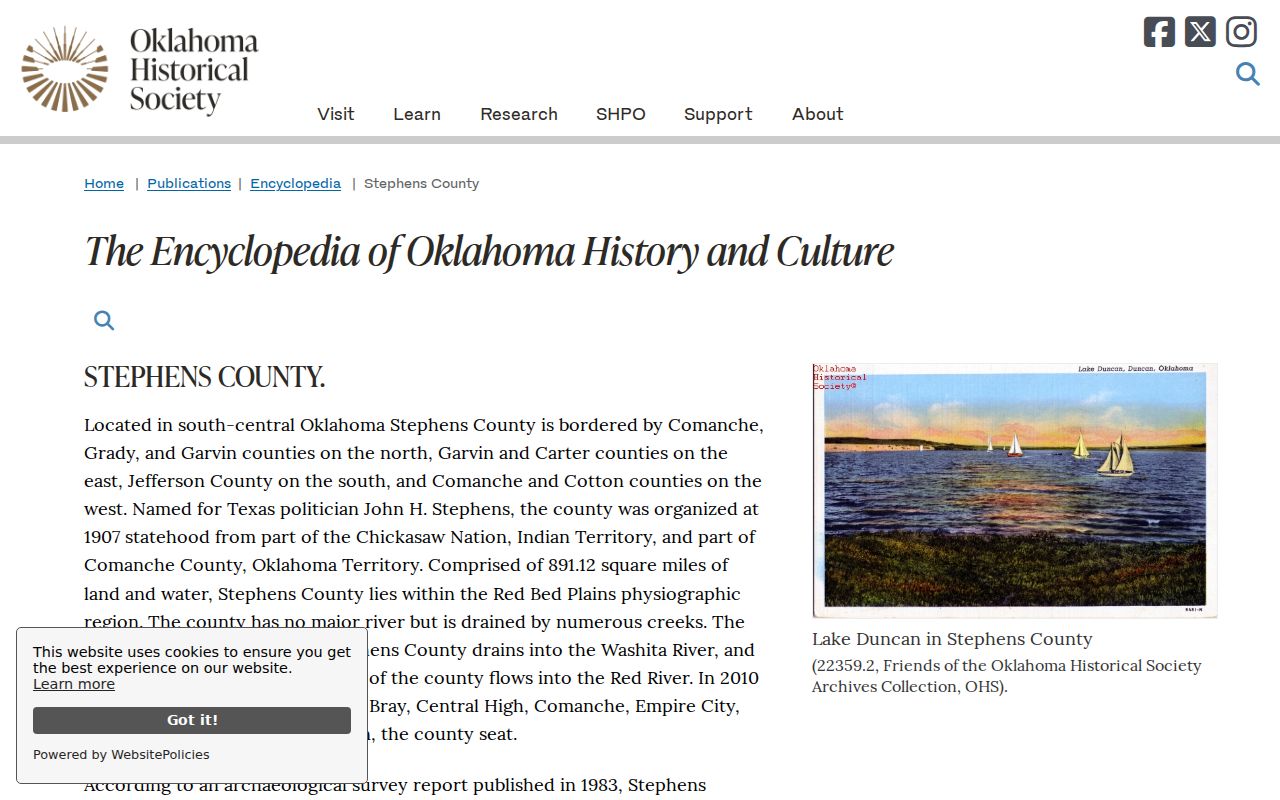
The county-history source is context for changing jurisdictions and dates, while the Clerk record remains the source for an individual recorded transfer.
Note: Cite the instrument and retrieval date, then request counter help for the next earlier link.
Duncan index gaps, Duncan image dates, Duncan counter requests, Duncan fee checks, and Duncan citations should be logged together.
Duncan Past Household Trail
Ownership is only one layer of who lived here before. The Stephens County Genealogy Library reports city directories, newspapers, obituaries, cemetery files, church yearbooks, family histories, and local files, but it does not publish a complete directory or reverse-directory run online. Ask staff which titles cover the address and years being studied. The collections themselves, including how to read a printed entry, are described on the Duncan city directory page.
- Choose a directory year close to the deed or other known event.
- Copy the printed address, name spelling, title, page, and abbreviation key.
- Check the next available directory year backward or forward, noting each address change as a separate observation.
- Pair the decade with the matching federal census and keep that citation separate from the directory.
- Use the Duncan Banner search, cemetery file, or newspaper microfilm to test a dated disappearance or move.
- Return to the deed chain if a later property transaction explains the timing.
A missing entry can mean a gap in the collection, an alternate spelling, a new jurisdiction label, or an unlisted person. It does not settle the question by itself. The library's staff, microfilm, and local files are the documented fallback when a catalog result is thin.
Duncan directory years, Duncan census dates, Duncan newspaper leads, Duncan cemetery files, and Duncan library formats need separate checks.
Duncan Previous Residents and Old Blocks
The 1908 Duncan Sanborn set contains seven sheets. It can connect a historic address to blocks, businesses, streets, and land use, but it does not identify modern occupants. For an old house, compare a cross street, block, business name, or parcel shape with the map, then use the deed legal description to avoid a false match.
OHS map holdings also include plats, fire-insurance maps, cemetery maps, railroads, streets, and boundary material. A map order or custom research request should be confirmed for current cost and timing. Map evidence can explain a changed street form, but it should not be used to invent an address transition where no primary source confirms one.
These layers are especially useful when a newspaper clipping names a commercial use rather than a dwelling. Keep the map, deed, directory, and clipping citations distinct.
Duncan Sanborn sheets, Duncan plats, Duncan deed language, Duncan blocks, and Duncan newspaper references answer different historical questions.
Duncan Previous Resident History Labels
Duncan research crosses several eras. OHS places the post office in 1884, the railroad in 1892, a 540-acre townsite survey in 1901, Stephens County organization and the county seat in 1907, and commercial oil development in 1918. Earlier records may use Indian Territory or Chickasaw context instead of a modern city and county label. Search both forms when a historical index appears to have a gap.
OHS Duncan history provides this chronology for a house-history search.
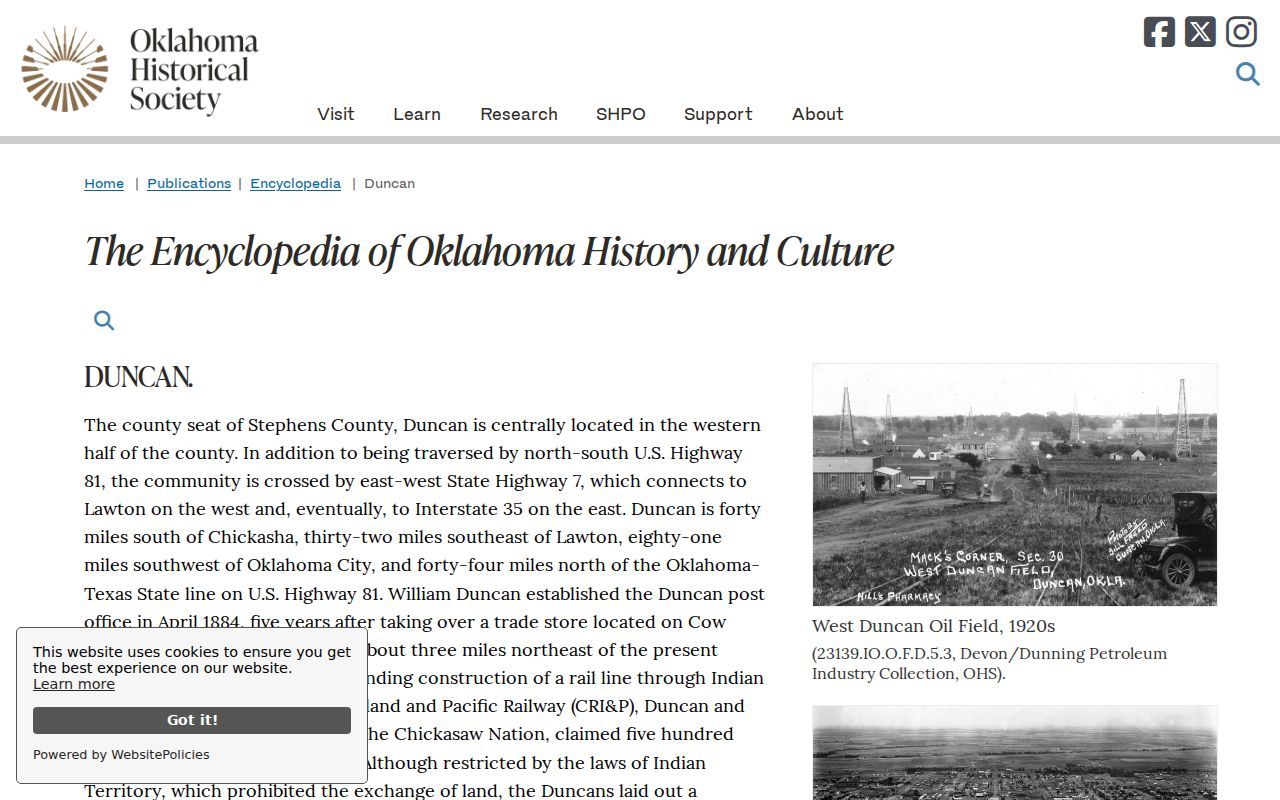
The chronology helps select appropriate record labels and dates before a directory, deed, or newspaper search is treated as a failed result.
The 1966 “Duncan is 75 Years Old” clipping is another dated local-media lead. Use it alongside OHS and primary records rather than as the sole support for a historical date.
The clipping's source and date metadata can support a research log while the deed, map, or directory supplies the specific address evidence.
Duncan era labels, Duncan townsite terms, Duncan county context, Duncan map dates, and Duncan clipping metadata should be compared.
Duncan Previous Residents Request Boundaries
Request only an existing, narrow record from the named custodian. A strong request identifies an address, parcel, legal description, instrument number, or date range. The City has no verified public permit index in the reviewed sources, so an address-specific planning, inspection, occupancy, zoning, or code-history request should be sent to the proper city custodian rather than assumed to be searchable online.
For a name-based historical lead, use an obituary, cemetery, directory, or newspaper citation and verify it with the original when possible. Do not combine unrelated records into a dossier, and do not treat an address, a mailing address, or a name match as proof of present physical presence.
The Stephens County Genealogy Library offers another documented fallback for a past-resident question that falls between the online Clerk years. Its collections include city directories, local newspapers, cemetery information, obituaries, marriages, church yearbooks, and family histories. The branch reports generally Monday through Thursday hours from 9 a.m. to 2 p.m., with appointments at other times, and lists 580-255-8718 for contact. Confirm hours, address, copying cost, and staff-research availability before a visit because those details can change.
A useful research request names the target years and asks whether the library has an original volume, microfilm, clipping, index, or vertical file. That format distinction matters. A newspaper index is a lead to an item; an original page or microfilm image supports the printed wording. The library reports five vertical-file cabinets and more than 10,000 items, so an unlisted address may still warrant a focused staff question rather than an assumption that no source survives.
Duncan request terms, Duncan target years, Duncan source formats, Duncan staff replies, and Duncan citations make a careful historical trail.
Lawful use. Duncan previous-resident research is suited to family history, estate questions, property history, and personal curiosity. Use the minimum necessary record and never use a result to harass, stalk, or harm a living person.